1. Why SEO prices vary so much
SEO is not one task.
A small local service business with ten pages and one location does not need the same amount of work as a national ecommerce store with hundreds of products.
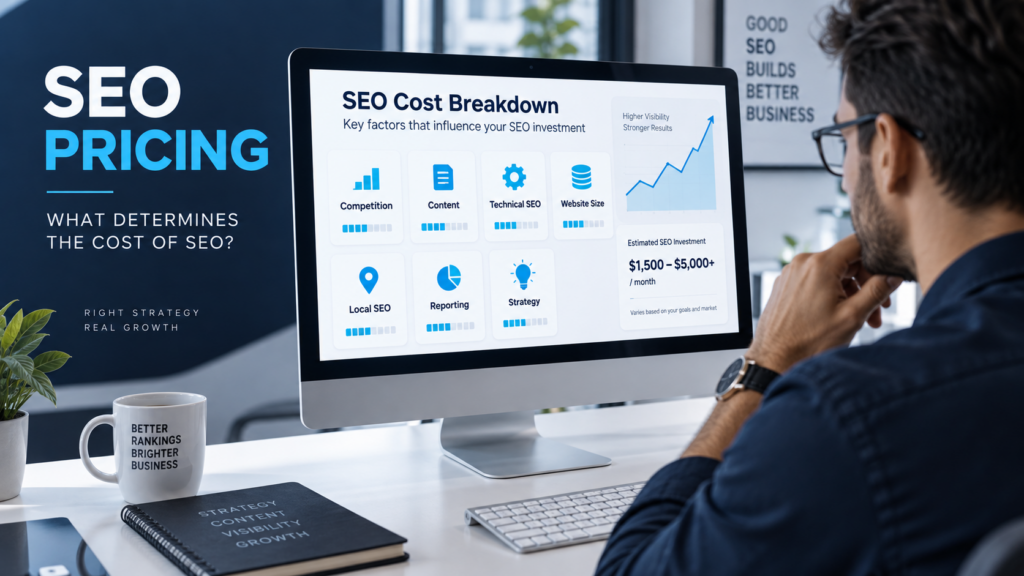
Price usually changes according to:
- how competitive your industry is,
- how many services or topics you want to rank for,
- whether you target one suburb, one city or the whole country,
- the current condition of your website,
- how much content needs to be created,
- whether technical problems need fixing,
- and whether authority/backlink work is required.
This is why one company can quote R4,000 per month and another R15,000 without either number automatically being wrong.
The scopes may be completely different.
2. What are you actually paying for?
A useful SEO quote should show where the work is going.
Technical SEO
This is the foundation that helps search engines access and understand the website.
It can include:
- crawl and indexing checks,
- XML sitemap setup,
- canonical checks,
- page-speed and mobile issues,
- broken links,
- site structure,
- redirects,
- structured data where relevant,
- and technical errors found in Search Console.
If Google cannot properly discover or process important pages, adding more content will not solve the underlying problem.
Our guide on how Google crawls and indexes your website explains this process in plain English.
Search and keyword research
This is not simply finding a list of high-volume phrases.
Good research asks:
- What are potential customers actually searching for?
- Which searches show buying intent?
- Which questions deserve articles?
- Which services need dedicated pages?
- Where is the website already getting impressions?
- Which topics are realistic opportunities?
Search Console can be especially useful here because it shows the queries Google is already associating with your website.
On-page optimisation
This includes improving the individual pages themselves:
- SEO titles,
- meta descriptions,
- headings,
- page copy,
- internal links,
- image context,
- URL structure,
- and alignment between the page and the searcher’s intent.
The aim is not to repeat a keyword twenty times.
It is to make the purpose of the page unmistakably clear.
Content
For many businesses, ongoing SEO eventually becomes a content problem.
You may need:
- new service pages,
- supporting articles,
- FAQs,
- local pages,
- product/category content,
- or updates to pages that are already getting impressions but not enough clicks.
Researching and writing useful content takes time, which is why content-heavy SEO campaigns normally cost more.
Authority and backlinks
Google does not evaluate a website in isolation.
Links and mentions from relevant, credible websites can help establish authority.
That does not mean buying hundreds of cheap backlinks.
A sensible backlink strategy focuses on legitimate opportunities such as:
- industry directories,
- suppliers and partners,
- professional associations,
- useful resources,
- digital PR,
- expert commentary,
- and genuinely link-worthy content.
The more competitive the market, the more important authority building can become.
3. Once-off SEO setup versus ongoing SEO
This distinction matters when comparing prices.
Once-off SEO setup
A new or redesigned website may need a defined SEO setup before launch.
That can include:
- keyword and search-intent planning,
- site architecture,
- titles and metadata,
- internal linking,
- sitemap configuration,
- Google Search Console,
- Google Analytics 4,
- indexing checks,
- and technical QA.
This adds time and cost to a website build, but it means the site launches with the basics considered from the beginning.
If you are comparing website quotes, our article on how much a website costs in South Africa explains why SEO and Google setup can legitimately push a build price higher.
Ongoing SEO
Ongoing SEO is different.
After launch, the work may continue through:
- new content,
- technical maintenance,
- Search Console analysis,
- page improvements,
- competitor research,
- backlink work,
- local SEO,
- and performance monitoring.
A once-off setup gives you a foundation.
An ongoing campaign keeps building on it.
4. What should a small business realistically budget?
For many small South African businesses, the first question should be whether they need maintenance, local visibility or active growth.
Around R3,000 – R8,000 per month
This range can make sense for:
- a small local business,
- a limited number of services,
- basic local SEO,
- small technical fixes,
- and lighter monthly optimisation.
The scope needs to stay realistic.
You should not expect a low-budget campaign to produce large volumes of new content, aggressive backlink outreach and constant technical work at the same time.
Around R8,000 – R20,000 per month
This is where more active SME campaigns often sit.
The work may include a stronger mix of:
- technical SEO,
- content creation,
- commercial page optimisation,
- Search Console analysis,
- internal linking,
- local SEO,
- and authority work.
R20,000+ per month
This becomes more reasonable when the business is competing nationally, has ecommerce complexity, operates across multiple locations or needs substantial content and authority building.
The website and commercial opportunity need to justify the spend.
SEO should not cost more simply because an agency has a bigger presentation deck.
5. Cheap SEO can become expensive
A low monthly price is not automatically bad.
But a price that cannot realistically cover the promised work should raise questions.
Be cautious when the offer includes:
- guaranteed first-place rankings,
- hundreds or thousands of backlinks,
- dozens of articles every month for almost no cost,
- no explanation of what work will actually be completed,
- no access to reporting,
- or no discussion about your business goals.
Google’s own SEO Starter Guide focuses on making sites understandable, useful and technically accessible. There is no legitimate shortcut that guarantees a particular ranking.
The danger with poor SEO is not only wasting the monthly fee.
You can also end up paying later to undo weak content, bad links or technical decisions.
6. How do you know whether SEO is worth the cost?
Do not judge SEO only by whether one keyword moved up two positions.
Look at whether the work is improving commercially useful visibility.
Useful questions include:
- Are impressions growing for relevant searches?
- Are more people clicking through?
- Are important service pages gaining visibility?
- Are enquiries increasing?
- Which articles or pages are attracting potential customers?
- Are technical indexing problems being resolved?
- Is the website becoming stronger over time?
Google Analytics and Search Console answer different parts of that picture.
If the numbers feel confusing, our guide to understanding website analytics explains what the main metrics actually mean.
7. What should you ask before accepting an SEO quote?
Before choosing a provider, ask for clarity on these points:
- What exactly is included each month?
- Which pages or topics are being prioritised?
- Will new content be created?
- Is technical SEO included?
- Is backlink work included, and how are links earned?
- Will Search Console and Analytics be used?
- How will progress be reported?
- What happens if the website itself is the main problem?
That final question matters.
Sometimes the best SEO recommendation is not another six-month retainer.
Sometimes the site first needs better pages, clearer structure, stronger content or technical fixes.
8. SEO should be an investment in a better website, not just rankings
So, what does SEO cost in South Africa in 2026?
For a small business, you will commonly see anything from a few thousand rand per month for limited/local work to R20,000 or more for active ongoing campaigns. Larger national and ecommerce strategies can go significantly higher.
The right number depends on the work required.
A useful SEO investment should leave you with more than a monthly ranking report.
Over time, it should help build:
- a technically healthier website,
- clearer service pages,
- useful content,
- stronger search visibility,
- better measurement,
- and a clearer understanding of what potential customers are actually looking for.
If your website is not generating leads or you are unsure whether the SEO foundations are set up properly, CPT Media’s website services are built around the website, Google visibility, tracking and conversion path together, rather than treating SEO as an isolated add-on.