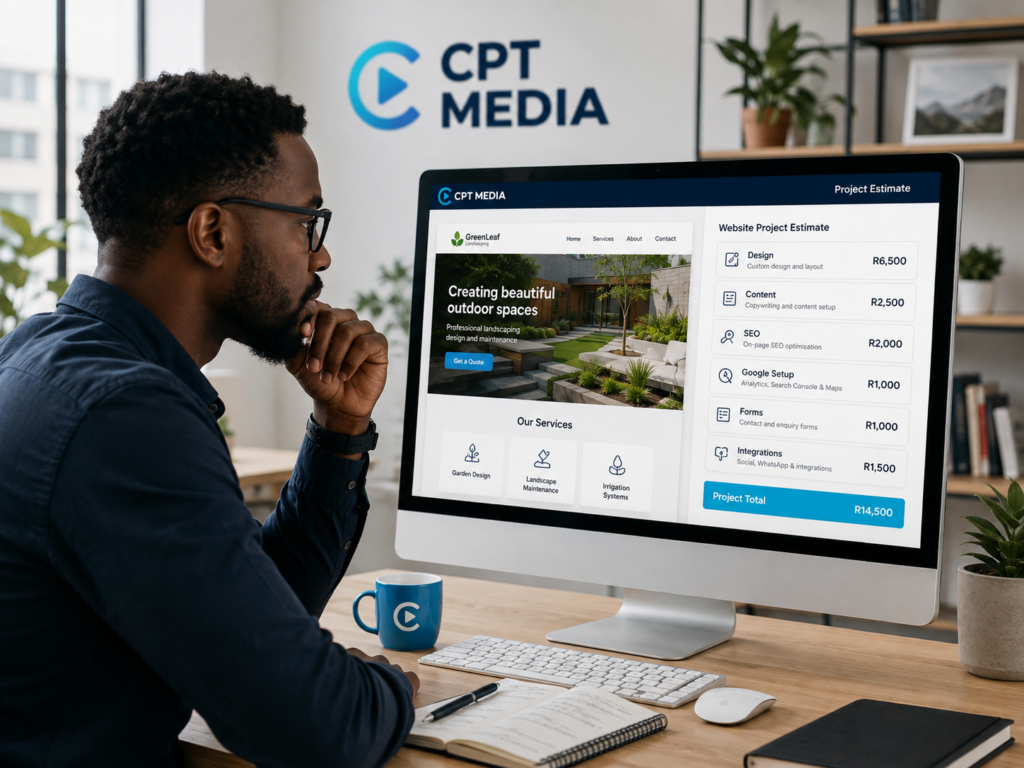
That R5,000 quote and R20,000 quote might not be selling the same thing
This is where website price comparisons become dangerous.
One quote might include:
- a template
- your supplied copy
- a few stock images
- a contact form
- mobile responsiveness
- launch
Another might include:
- research
- website planning
- customer and search-intent analysis
- page architecture
- custom design
- content planning
- SEO foundations
- conversion paths
- Search Console
- Analytics
- event tracking
- integrations
- content-management planning
- testing
- post-launch support
Calling both of them a five-page website makes them sound comparable.
They are not.
One person is selling you five pages.
The other may be building part of your marketing system.
Stop asking how many pages you get
This is probably one of the worst ways to judge a website quote.
“How many pages do I get?”
As many as the website actually needs.
A twenty-page website full of useless content is not automatically better than a seven-page website built around exactly what your customers are searching for.
The better questions are:
What is every page supposed to accomplish?
Why does it exist?
Who is it for?
How does someone find it?
Where should that person go next?
That is website strategy.
The page count comes afterwards.
Your website needs to be built around how customers actually look for you
Imagine you own an accounting business.
You offer tax returns, bookkeeping, payroll and company registrations.
You could put all four on one generic Services page.
Cheap. Quick. Done.
But your potential customer may be searching Google for:
bookkeeping services Cape Town
or:
small business payroll services
or:
company registration help
Those are completely different needs.
Now the structure of the website starts to matter.
Which searches deserve their own page?
What should those pages explain?
How should they link together?
What should someone do after reading them?
This is where a website stops being a collection of pages and starts becoming something that can actually support marketing.
Google’s own SEO Starter Guide makes the same basic point: websites should make it easy for both people and search engines to understand their content.
That should be considered while the website is being built.
Not six months later when someone asks why Google is not sending any traffic.
Looking good is the minimum requirement
A professional website should look good.
Obviously.
But looking good is not the finish line anymore.
You can buy an attractive WordPress template today.
You can generate decent layouts with AI.
You can have a freelancer make something visually impressive fairly quickly.
The question is:
What happens after somebody sees it?
Do they understand the offer?
Do they know what to do next?
Does the page answer the question that brought them there?
Does the website capture useful data?
Can you see whether people are converting?
A beautiful website that nobody finds and nobody acts on is still failing.
It is just failing beautifully.
Launching the website is not the end of the project
This is another place where buying purely on price can screw you later.
The website goes live.
Everyone celebrates.
The invoice gets paid.
And then nothing happens.
Three months later:
You have no idea what people are searching for.
You do not know which pages they are landing on.
You do not know whether they are clicking your buttons.
You do not know which services Google is starting to associate with your business.
You do not know where people are leaving.
You do not know what should be improved next.
The website is online.
But you are flying blind.
The useful work starts once real people begin using the website
Once the website is live, you start getting something you did not have during the build.
Real data.
Google Search Console can start showing what people searched before seeing your website.
Analytics can show which pages they visit.
Conversion tracking can show what they actually do.
You might discover that a service you barely mentioned is receiving impressions.
You might discover that Google is showing one page for searches you expected another page to rank for.
You might discover that hundreds of people visit a service page and almost nobody contacts you afterwards.
That is useful information.
Now you can do something about it.
The website should get better after launch
You might change a heading.
Rewrite a service page.
Add a new article.
Build a dedicated page around a search query that keeps appearing.
Improve an existing page instead of creating another one.
Change a call to action.
Improve the navigation.
Add proof.
Answer a question customers repeatedly ask.
That is how a website becomes more valuable over time.
Not by launching it and leaving it untouched for three years.
This is where the cheap website can become very expensive
Maybe you saved money on the initial build.
Great.
But now you want to know what people are searching for.
Search Console was never configured.
You want to measure enquiries.
Nobody set up the tracking.
You want to publish useful articles.
The site was never structured properly for content.
You want your marketing person to make changes.
They have to work through the full WordPress backend and are terrified of breaking something.
You want a new service page.
The original structure does not support it cleanly.
Now you start paying again.
And again.
And again.
This is the part that does not appear in the cheap quote.
The right question is not “How much does a website cost?”
That is still an important question.
You have a budget.
Every business does.
But it should not be the only question.
Ask:
What do I need this website to do?
Then ask:
What does it take to build that properly?
Now the price actually means something.
A R5,000 website that genuinely does everything your business needs could be fantastic value.
A R40,000 website that does nothing useful could be a complete waste of money.
The number alone tells you nothing.
And then ask what happens after launch
This is the question we think businesses should ask far more often.
Once the website exists:
Who updates it?
Who publishes new content?
Who watches what people are searching for?
Who checks which pages are working?
Who notices when rankings start moving?
Who looks at Analytics?
Who turns that information into the next change?
Because the website should not operate separately from the rest of your marketing.
That is part of the reason we built the CPT Media Marketing Dashboard.
It brings the ongoing work closer together.
Website content.
Content planning.
Social media.
Analytics.
Search performance.
The things you need after the website has been built.
You do not need to buy another website to make an existing one more useful.
Sometimes you just need to start paying attention to what happens after launch.
If that side of website management sounds more useful than simply paying for five pages and hoping for the best, take a look at the CPT Media Marketing Dashboard.